How long does a DBS check last?

Short answer: a DBS check never legally expires. There is no end date printed on the certificate. It only shows what was on record the day it was issued, so it is up to each client or organisation to decide when they want a newer one. In practice, many ask for a fresh check every one to three years, and you can avoid reapplying altogether by joining the DBS Update Service.

So does a DBS check actually expire?

No. This is the part that trips people up, so it is worth being blunt about it. A DBS certificate has no official validity period. The day it lands on your doormat, it is already a snapshot of the past, accurate as of the date it was issued and nothing after that. If you picked up a conviction the following week, your existing certificate would not show it.

That is the whole reason the question is so common. People assume there is a hidden expiry date somewhere on the paperwork, tucked next to the certificate number. There isn’t. What changes over time is not the certificate’s legal status but how much an organisation trusts it, and those are two very different things.

Why there is no fixed expiry date

The Disclosure and Barring Service issues your certificate and then steps back. It does not keep watching you, it does not update the document, and it will not send you a reminder when it thinks the check is getting old. The certificate is a point-in-time record, not a rolling licence that quietly renews in the background.

Because of that, the law leaves the decision about freshness to whoever is relying on the check. For an employed person, that is the employer. If you are self-employed, the responsibility usually lands on the client, the parent, the care recipient, or the licensing body asking to see it. They set the bar for how recent a check needs to be, and that bar moves depending on the work and the sector.

What actually changes after your certificate is issued

Since the certificate itself never expires, it helps to be clear about what is really ageing here. It is the information, not the paper.

On the day it is printed, the certificate reflects everything relevant held about you at that moment: convictions, cautions, and, for enhanced checks, any local police information and a barred list result where the role qualifies. The next day, that picture is frozen. Anything that happens afterwards, good or bad, simply is not on it.

For most people, nothing changes for years and the certificate stays an accurate reflection of their record. The problem is that a client cannot know that just by looking at an old document. A three-year-old certificate might be a perfect record of someone with nothing to hide, or it might be missing something significant. From the outside, the two look identical. That uncertainty is what drives the renewal habits below, far more than any rule.

Can Self-Employed People Apply for an Enhanced DBS Check?

Until January 2026, the answer was no. Self-employed individuals could only obtain a Basic DBS check, which shows unspent convictions only. An Enhanced check required an employer or organisation to countersign the application, leaving self-employed workers with no independent route to obtain one.

A Statutory Instrument laid before Parliament on 20 November 2025 changed this. It amended Part V of the Police Act 1997 and came into force on 21 January 2026. Since that date, paid self-employed individuals working in regulated activity in England and Wales can apply for an enhanced DBS check, or an Enhanced check with barred list checks, through a registered platform.

This route applies to paid self-employed work only. Volunteers are not covered.

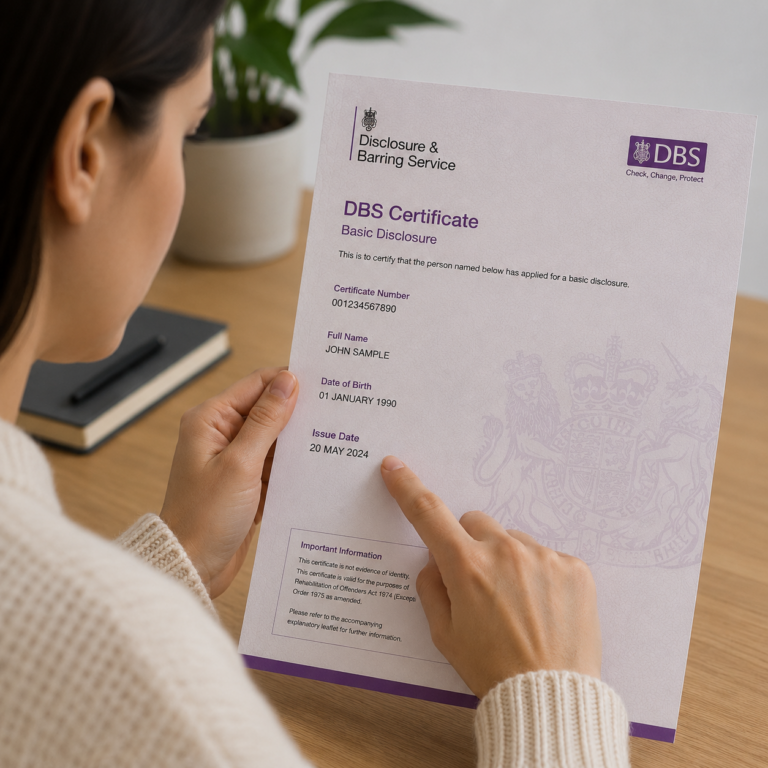
Person reviewing a DBS certificate and checking the issue date on the document at a desk in a professional office setting.

How to Get an Enhanced DBS Check as a Self-Employed Person

Applying for an individual DBS check as a self-employed person follows five steps. The process is the same whether you need a Standard, Enhanced, or Enhanced with barred list check.ย 

Check eligibility

You must be paid and in a qualifying role. Volunteers are not covered.

Register an account

Self-employed applicants cannot submit directly to the DBS.

Complete application

Personal details, 5 years of addresses, and your role information.

Verify your identity

Digitally via biometric passport or EU ID card, or with standard documents.

Receive your certificate

Posted directly to you. Show the original to your client or parent.

How long does an enhanced DBS last compared to standard and basic?

People often ask whether an enhanced check lasts longer than a basic one. It doesn’t. The level of the check changes what information it reveals, not how long it stays valid. A basic, standard, and enhanced certificate all last exactly the same amount of time, which is to say none of them expires and all of them start ageing the moment they are printed.

What differs is expectation. The higher the risk attached to a role, the sooner people tend to want a recent check. Here is how that usually plays out across the three levels.

DBS level Official expiry Typical refresh clients ask for Eligible for the Update Service?
Basic None 1 to 3 years, or per contract No
Standard None Often around 3 years Yes
Enhanced None 1 to 3 years (sooner in higher-risk roles) Yes

No level has a legal expiry date. The refresh column reflects common practice, not a rule.

Where the three-year idea comes from

If you have ever been told a DBS “lasts three years,” that came from a person or an organisation, not from the law. Three years is the figure you will hear most often, mostly because a lot of organisations picked it as a sensible internal policy years ago and everyone copied each other. It has no legal weight at all.

It stuck around because it is a reasonable compromise. Long enough that people are not constantly reapplying, short enough that a certificate does not go badly out of date. Treat it as a useful rule of thumb for what a cautious client might expect, not as a deadline that switches your certificate off.

When clients and sectors expect a new one

There is no universal renewal rule, but some clear patterns come up across different lines of work. A few are worth knowing if you want to stay ahead of what a client is likely to ask for.

Taxi and private hire is the strictest example. Many licensing authorities now require drivers to hold an enhanced check and to stay signed up to the Update Service, with the licensing team re-checking the status on a short cycle, often every six months. If you drive, your council’s policy is the rule that matters, and it tends to be tighter than anywhere else.

Care and healthcare sit close behind. Providers regulated by the Care Quality Commission set their own refresh policies, and three years is a common choice. Families arranging their own care privately are less formal about it, but a recent check still does a lot to reassure someone inviting you into their home.

Education and childcare vary by setting. Schools and supply agencies often refresh checks for the people they take on, and agencies in particular lean on the Update Service so they can verify quickly between placements. Sports governing bodies, faith organisations, and youth groups frequently run their own three-year cycle as part of their safeguarding policy.

For most self-employed people working directly with families, the honest answer is simpler than any of this. A check more than a couple of years old starts to feel stale to the person hiring you. A recent certificate is reassuring. A four-year-old one quietly invites the question of what has happened since.

The DBS Update Service: how to make one check last for years

This is the part worth slowing down for, because it changes the answer to “how long does a DBS last” from “until someone wants a newer one” to “indefinitely, as long as you keep it subscribed.”

The DBS Update Service is an online subscription that keeps your certificate live. Instead of reapplying, you let clients run a free online status check that confirms whether your certificate is still current or whether new information has come to light since it was issued. If nothing has changed on your record, the same certificate keeps doing its job year after year.

Here is how it works in practice. You register the certificate, your client asks to see the original once and notes the certificate number, and from then on they check its status online whenever they need reassurance. The check tells them, in a line or two, whether the certificate still stands. They never have to wait for a new application, and you never have to start one.

A few details matter:

  • It costs ยฃ16 a year, and it is free for volunteers.
  • You can register as soon as you apply using the application reference number, or within 30 days of the date your certificate is issued. Miss that window and you would need a brand new check to join.
  • It covers standard and enhanced checks. Basic checks are not eligible.
  • It only works while a new role needs the same type and level of check, and the same workforce, as the certificate you registered.
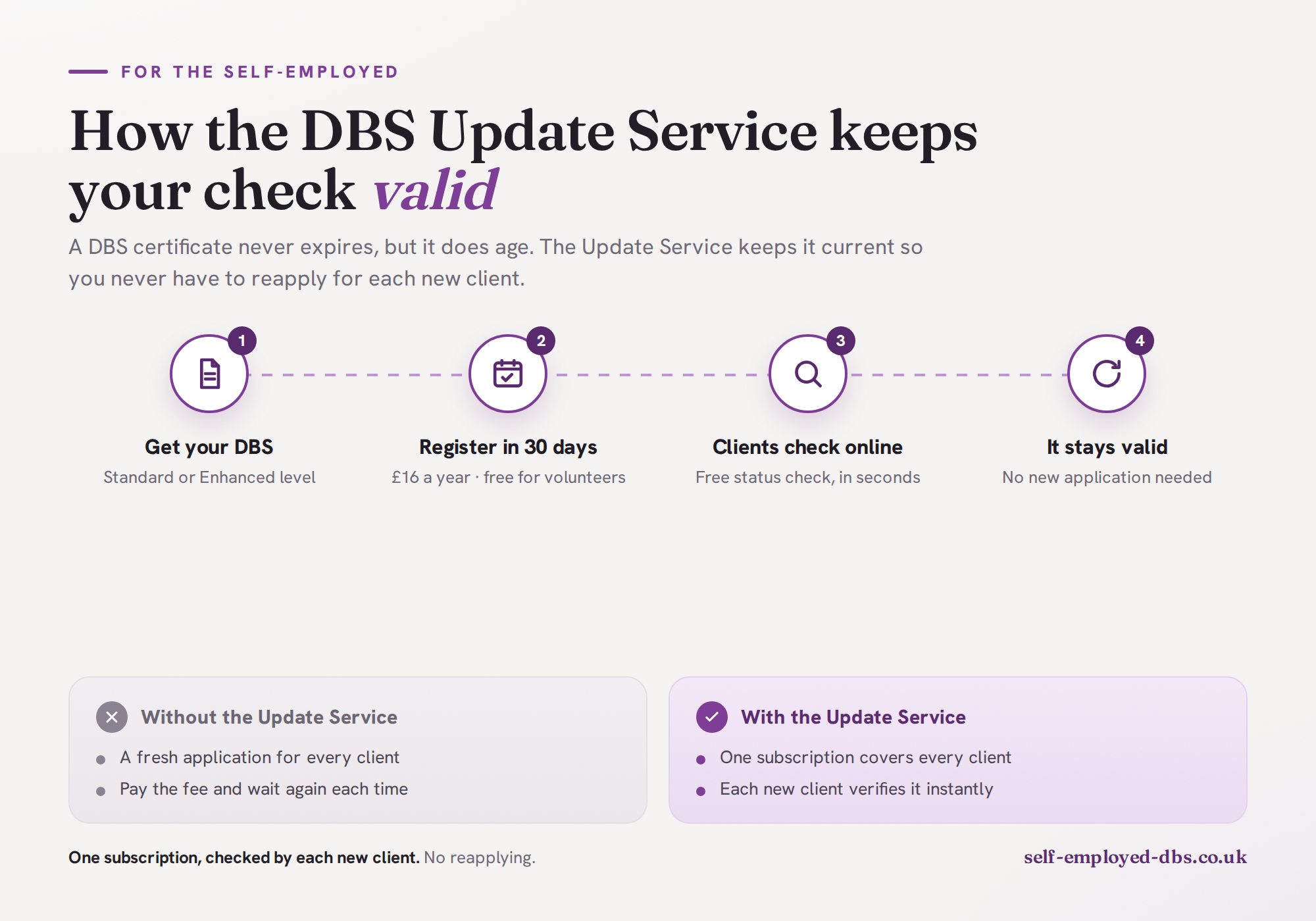
How the DBS Update Service keeps a DBS check valid
One subscription, checked by each new client, no reapplying.

What if your DBS is already a few years old?

Plenty of people reading this already hold a certificate and are wondering whether it still counts. There is no automatic answer, but a couple of questions make the decision easy.

First, are you on the Update Service? If you are, the age of the paper barely matters. A client confirms the status online and gets a current result, even if the certificate was issued years ago. If you are not subscribed and the 30-day window has long passed, that option is off the table for this certificate, and a new application is the only way to get back onto it.

Second, what is the client actually asking for? Some will happily accept a certificate that is a year or two old. Others, especially in regulated work, will want something recent or will only accept an Update Service check. If a contract is riding on it, it is usually quicker and cheaper to sort a fresh check early than to lose the work while one is in progress.

What this means if you are self-employed

For sole traders the Update Service is close to essential, and the reason is simple: you do not have one employer, you have many clients. Without it, every new client who wants reassurance could mean another application, another wait, and another fee. With it, each client just runs a status check and gets their answer in seconds, no matter how many of them you take on in a year.

Since the January 2026 law change, self-employed workers can finally apply for their own enhanced DBS check through a registered umbrella body, rather than relying on an employer to arrange it. If you have gone to the trouble of getting one, putting it straight onto the Update Service is usually the cheapest way to keep it useful for the long run. The 30-day window is the only catch, so set a reminder the moment you apply rather than after the certificate arrives.

It also helps to think about how you present it. A client who can verify your check in seconds is far more likely to book you than one who has to take your word for it or wait weeks. Treating a live, verifiable DBS as part of how you market yourself, rather than a box you ticked once, is one of the quiet advantages the new rules give self-employed workers.

If you want the numbers, our page on DBS check costs for the self-employed breaks down the fees, and if you are not sure which level you need in the first place, the basic vs standard vs enhanced guide is the place to start.

How to check the date on your certificate

If you already hold a certificate and want to know where you stand, find the issue date printed on it. That date is your only reference point. Count forward from there, not from when you started the role or when you remember filling in the form.

Then ask the one question that really matters: does the person relying on this check think it is recent enough? If you are subscribed to the Update Service, you can sidestep the guesswork entirely, because they can confirm the status themselves. If you are not, and the certificate is getting on for a few years old, it is worth getting ahead of it before a client has to ask.

One last thing people mix up. How long a check lasts is not the same as how long it takes to come through. If you are waiting on a new application right now, our guide on how long a DBS check takes covers the timings.

The bottom line

A DBS check does not expire, but it does age. There is no date that makes it invalid, only a point where the person trusting it decides it is too old to be reassuring. For self-employed workers juggling several clients, the Update Service is the practical fix: one check, kept live, verified by anyone who needs to see it. Register within 30 days of your certificate’s issue date and the question of how long your DBS lasts mostly stops being a question at all.

Frequently asked questions

Does a DBS check expire after 3 years?

No. The three-year figure is a common renewal policy, not a legal expiry. A DBS certificate has no official end date. Many organisations simply choose to ask for a new one every three years.

How long is an enhanced DBS valid for?

An enhanced DBS has no fixed validity period, the same as every other level. How recent it needs to be depends on the client, sector, or licensing body relying on it, with one to three years being common.

Can I keep my DBS check valid without reapplying?

Yes. Joining the DBS Update Service keeps a standard or enhanced certificate live for ยฃ16 a year. Clients then verify its status online instead of asking you to apply again. You must register within 30 days of the certificate’s issue date.

Does a DBS check still count if I change jobs or clients?

It can, as long as the new role needs the same type and level of check. If you are on the Update Service, a new client can confirm this online. If you are not, they may decide they want a fresh check.

How long does a basic DBS check last?

A basic DBS check has no expiry date either, but it cannot be added to the Update Service. Because it only shows unspent convictions, clients often treat it as something to refresh more frequently.


This guide applies to self-employed workers in England and Wales only. Self-employed workers in Scotland should apply through Disclosure Scotland. In Northern Ireland, the equivalent service is AccessNI. This page is for guidance only and does not constitute legal advice. If you have questions about your specific circumstances, contact our support team or consult a qualified legal adviser.


Ready to apply for your DBS check as a sole trader?ย 

Self-employed-dbs.co.uk processes Enhanced and Standard DBS applications for self-employed workers in England and Wales. No employer needed.

Share This :

Need to ask a question before registering…?

If you are already a customer, please login and use the regular support channels on the platform

Need to ask a question before registering…?

If you are already a customer, please login and use the regular support channels on the platform