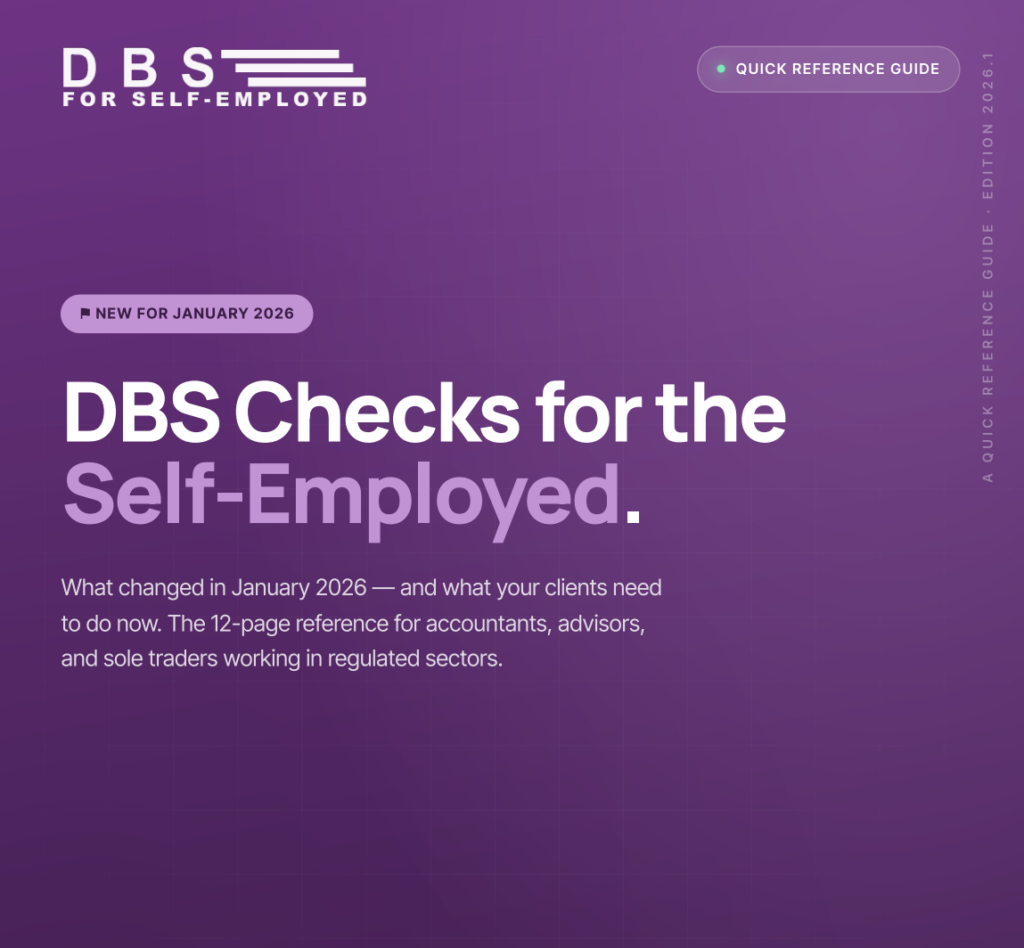
January 2026 changed the rules for self-employed workers in regulated sectors. For the first time, sole traders, freelancers, and contractors can apply for an Enhanced DBS check without needing an employer to sponsor them. It is a significant shift, and one that a lot of self-employed people and the advisors supporting them are still catching up with.
To help with that, we have put together a free quick reference guide covering exactly what changed, who it affects, and what to do next.
What the guide covers
The 2026 guide is built for three audiences: accountants and bookkeepers advising sole trader clients, HR and compliance professionals working with contractors, and self-employed individuals trying to work out what they actually need. It cuts through the confusion around eligibility, check levels, and the application process in one place.
Inside, you will find a clear before-and-after breakdown of what changed in January 2026, a plain-English explanation of the difference between a Basic and an Enhanced DBS check, and a role-by-role matrix covering common self-employed roles from nannies and childminders to private tutors, care workers, locum healthcare workers, and counsellors and therapists. It also walks through the five-step application process, what turnaround times to expect, and how the DBS Update Service works for people serving multiple clients.
There is also a section on six things every self-employed client should know, covering validity, UK-only coverage, filtering rules, Barred Lists, and disclosure. The kind of detail that prevents problems later and the sort of thing a good advisor should have to hand.
Who it is for
If you work in accountancy or financial advice and have sole trader clients in regulated sectors, this guide is worth keeping as a reference. The same goes for anyone self-employed who has been asked to provide a DBS certificate by a client and is not sure where to start.
The guide is free. You do not need an account to access it, and it is formatted as a print-ready reference you can share with clients directly.
You can check DBS check costs for self-employed workers and use the eligibility check tool alongside it if you want to confirm what level applies before applying. The FAQ page is also there if anything needs clarifying.
Download the free 2026 guide and apply directly at self-employed-dbs.co.uk with no employer or sponsor required.
Download Today
Self-employed-dbs.co.uk processes Enhanced and Standard DBS applications for self-employed workers in England and Wales. No employer needed.
This guide applies to self-employed workers in England and Wales only. Self-employed workers in Scotland should apply through Disclosure Scotland. In Northern Ireland, the equivalent service is AccessNI. This page is for guidance only and does not constitute legal advice. If you have questions about your specific circumstances, contact our support team or consult a qualified legal adviser.