DBS Changes 2023: The Last Major Update Before 2026
When people search for DBS changes 2023, they are usually referring to the last significant set of updates to how Disclosure and Barring Service checks were administered and interpreted.
The 2023 changes focused primarily on clarification rather than structural reform. They reinforced existing eligibility rules, tightened guidance around workforce categories, and reaffirmed that Enhanced and Barred List checks must only be used where roles are legally eligible.
What the DBS changes 2023 did not do was solve a long-standing structural problem for self-employed individuals. Despite clearer guidance, the system still assumed an employment relationship. Enhanced DBS checks continued to require an organisation to act as the applicant’s sponsor.
For self-employed professionals working with children or vulnerable adults, that limitation remained firmly in place.
As a result, 2023 became known as the last major guidance-led update to the DBS framework. The next significant shift would require legislation. That shift arrived in January 2026.
DBS Changes 2026: Why This Update Is Fundamentally Different
The DBS changes 2026 represent the most substantial reform since before 2023. Unlike the earlier update, the 2026 changes introduce a formal legal mechanism that directly affects how self-employed individuals access Enhanced and Enhanced with Barred List DBS checks.
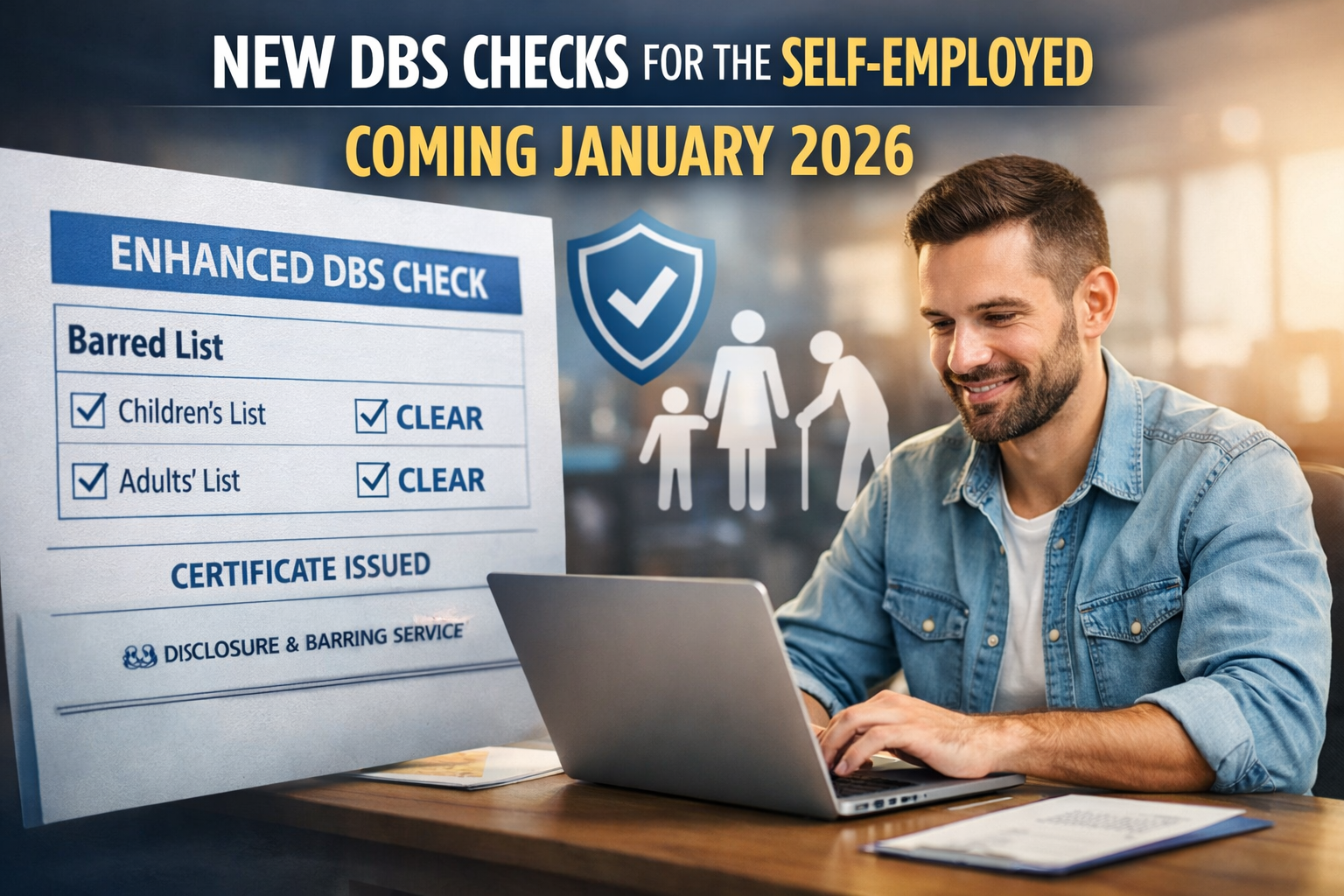
From January 2026, self-employed individuals can lawfully apply for Enhanced DBS checks through a DBS-registered Umbrella Body. This route is no longer informal, discretionary, or reliant on interpretation of guidance. It is now explicitly supported by legislation.
The difference between DBS changes 2023 and DBS changes 2026 is simple but critical:
-
2023 clarified who should have Enhanced checks
-
2026 changes who is allowed to apply for them
That distinction matters for safeguarding, compliance, and commercial credibility.
Why the Pre-2026 System Failed the Self-Employed
Before the DBS changes 2026, the DBS framework created a practical dead end for self-employed professionals.
Basic DBS checks were always available to individuals directly. Standard and Enhanced checks were not. They required an organisation to submit and countersign the application. This made sense in a traditional employment model, where an employer had responsibility for vetting staff.
Self-employed individuals had no employer. No countersignatory. No organisation to submit the application. Even where the work clearly required an Enhanced check, there was no consistent lawful route to obtain one.
A self-employed tutor working with children, a freelance therapist operating in schools, or a personal care assistant supporting adults at home could all be performing regulated activity. Yet they were structurally blocked from accessing the correct level of DBS check.
Some Umbrella Bodies offered limited workarounds, but these relied on guidance rather than statute. They were inconsistent, cautious, and often unavailable. The DBS changes 2023 did not resolve this. The DBS changes 2026 do.
What the DBS Changes 2026 Introduce
The January 2026 legislation formally establishes a statutory route for self-employed individuals to apply for:
-
Enhanced DBS checks
-
Enhanced DBS checks with Children’s Barred List
-
Enhanced DBS checks with Adults’ Barred List
-
Enhanced DBS checks with both Barred Lists, where eligible
Applications are made through a DBS-registered Umbrella Body, which acts as the sponsoring and countersigning organisation.
This is not a new type of DBS check. The check levels remain unchanged. What has changed is access. The DBS changes 2026 remove the employment-only barrier that previously prevented self-employed professionals from applying.
Enhanced DBS Eligibility After the DBS Changes 2026
The DBS changes 2026 do not lower eligibility thresholds. Enhanced checks are still restricted to roles that legally qualify.
Eligibility continues to depend on the nature of the work, not employment status. To qualify for an Enhanced DBS check, a self-employed individual must be undertaking work that involves:
-
Regular contact with children or vulnerable adults
-
Regulated activity in sectors such as education, healthcare, childcare, or personal care
-
A role that would require an Enhanced check if carried out by an employee
The eligibility test itself is unchanged from the DBS changes 2023. What has changed is that self-employed individuals can now lawfully submit an application via an Umbrella Body.
For Enhanced DBS checks with Barred List information, the role must constitute Regulated Activity as defined under the Safeguarding Vulnerable Groups Act 2006. Children’s and Adults’ Barred Lists can be requested separately or together, depending on the role.
Applying Under the DBS Changes 2026: The Umbrella Body Route
Under the DBS changes 2026, the application process for self-employed individuals follows a defined structure.
- Step 1 – Confirm Eligibility
Applicants must confirm that their role qualifies for an Enhanced check. The DBS Eligibility Tool and regulated activity definitions remain the authoritative reference points. - Step 2 – Register With a DBS-Registered Umbrella Body
A registered Umbrella Body must act as the sponsoring organisation. Platforms built for self-employed applicants capture business context, assess eligibility, and provide a compliant submission route. - Step 3 – Select Check Level and Workforce
Applicants specify whether they require an Enhanced check or Enhanced with Barred List information and select the relevant workforce: Children, Adults, or both. - Step 4 – Complete the DBS Application
Personal details, address history, and role information are submitted through the Umbrella Body system. - Step 5 – Identity Verification
Identity is verified in line with DBS ID Checking Guidelines. Digital verification options reduce delays and administrative effort. - Step 6 – Submission to DBS
Once verified, the Umbrella Body submits the application to DBS for processing.
Why DBS Changes 2026 Were Necessary
The safeguarding logic behind the DBS changes 2026 is direct.
Following the DBS changes 2023, the system still treated self-employed professionals as an edge case, despite their growing presence in safeguarding-sensitive roles. This created inconsistency. Two people performing the same work could be subject to different vetting standards based solely on employment status.
That inconsistency posed a safeguarding risk. Children, vulnerable adults, and commissioning organisations were relying on professionals whose suitability may not have been assessed at the correct level.
The 2026 changes bring the system back into alignment with how work is actually delivered.
Practical Impact of DBS Changes 2026
For self-employed professionals, the DBS changes 2026 remove a long-standing barrier.
Independent tutors, freelance therapists, self-employed carers, and sole traders working in schools or care environments now have a clear, lawful route to Enhanced DBS checks.
This is not only a compliance issue. Many organisations and private clients require Enhanced DBS evidence before engagement. The absence of a legitimate route previously resulted in lost work and rejected referrals. The DBS changes 2026 resolve that.
Acting After DBS Changes 2026
Anyone searching for DBS changes 2023 should understand that 2023 was the last major guidance update. The real structural reform arrived with the DBS changes 2026.
Self-employed individuals working with children or vulnerable adults should reassess their DBS position. Where an Enhanced check was previously unobtainable, a lawful route now exists through a registered Umbrella Body.
Eligibility must still be confirmed. Ineligible applications will be rejected. The difference is that eligibility can now be acted on.
The system has changed. The route exists. For self-employed professionals in safeguarding roles, the implications of the DBS changes 2026 are immediate.